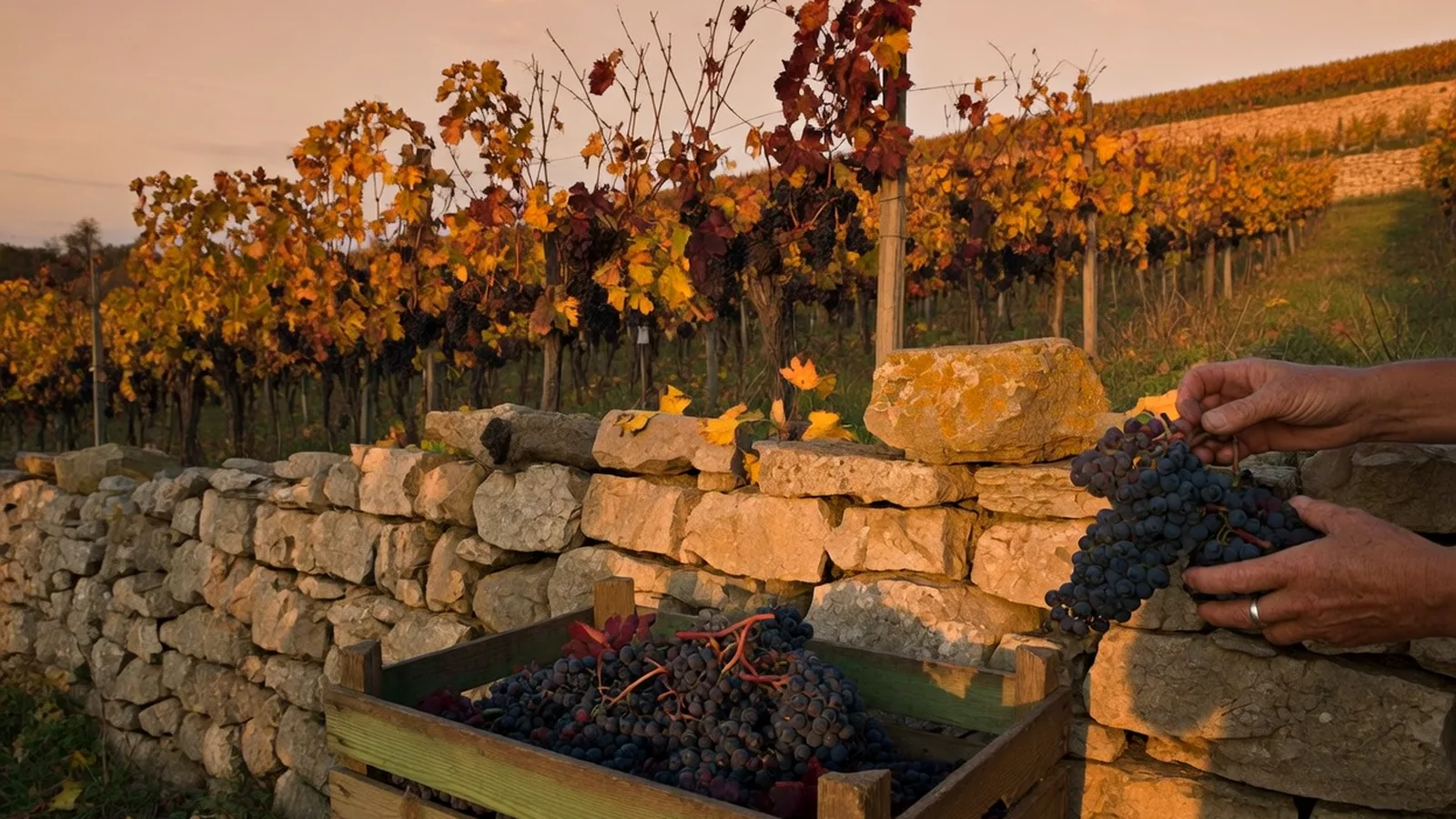
France has 750,000 hectares of vineyards — a living landscape that has been cultivated for over 2,000 years. More than any other crop, la vigne (the vine) defines the visual character of rural France. Vineyards terrace hillsides, stripe valley floors, and carpet plateaus from Champagne to Corsica. Several French vineyard landscapes are UNESCO World Heritage Sites — recognised not just for their wine, but for the way human cultivation has shaped the land.
| French Vineyards | Detail |
|---|---|
| Total vineyard area: ~750,000 hectares (world's second largest after Spain) | |
| Wine regions: 17 major appellations, 300+ AOC/AOP designations | |
| UNESCO vineyard landscapes: Burgundy Climats, Champagne, Saint-Émilion, Loire Valley | |
| Harvest season: Late August (south) to late October (north, Champagne) | |
| Oldest vines: Arbois, Jura — continuous cultivation since the 10th century |

Burgundy — The Climats
The Climats (individually named vineyard plots) of Burgundy are UNESCO-listed — 1,247 precisely defined parcels on the Côte de Nuits and Côte de Beaune, each claimed to produce wine with a distinct character. The landscape is modest in scale — a gentle east-facing escarpment of limestone, each plot sometimes just a few rows wide — but the cultural significance is immense. The French concept of terroir (the taste of place) was invented here.
Champagne — Chalk Beneath the Bubble
The Champagne vineyards (Reims, Épernay, Côte des Blancs) are among the northernmost in France — a borderline climate that produces the high acidity essential for sparkling wine. The landscape is softly undulating chalk hills, the white soil visible between vine rows. Beneath the surface, 200 km of crayères (chalk cellars) hold millions of ageing bottles. UNESCO World Heritage since 2015.
Bordeaux — The Great Estates
Bordeaux's landscape is flat to gently rolling — the vineyards are distinguished not by dramatic terrain but by the architecture of the châteaux (wine estates) that dot the countryside. The Left Bank (Médoc, Graves) is gravel-topped plains; the Right Bank (Saint-Émilion, Pomerol) is clay-limestone slopes. The medieval town and vineyards of Saint-Émilion — UNESCO World Heritage since 1999 — are the scenic highlight.
Alsace — The Wine Road
The Route des Vins d'Alsace (Alsace Wine Route) runs 170 km along the eastern foothills of the Vosges — a ribbon of vineyards threading between half-timbered villages and forested mountains. The landscape is intimate: steep terraced slopes, stone walls, autumn colours that rival New England.
The Rhône Valley
Two landscapes in one: the northern Rhône (Côte-Rôtie, Hermitage, Condrieu) features impossibly steep granite terraces — some of France's most dramatic vineyard sites, cultivated by hand. The southern Rhône (Châteauneuf-du-Pape, Gigondas) is wider, warmer, and floored with distinctive galets roulés (large round stones) that store daytime heat and reflect it onto the vines.
The Loire Valley
The longest wine-producing valley in France — 400+ km from Muscadet (Nantes) to Sancerre (central France). The vineyard landscape is gentle, green, and interwoven with châteaux, troglodyte caves (carved into the tufa cliffs where wine is also stored), and the Loire river itself.
The Seasonal Cycle
The vine's annual cycle is a calendar of changing landscape:
- January–FebruaryBare vines, skeletal rows on frost-whitened slopes. Pruning — patient hand work.
- March–AprilBuds swell. Frost danger — growers light smudge pots and candles in the vineyards.
- May–JuneGreen explosion. Shoots lengthen, leaves unfurl, vines flower (briefly).
- July–AugustCanopy thickens. Grapes colour — véraison turns red grapes from green to purple.
- September–OctoberVendanges (Harvest) — the climax. Workers (or machines) in the rows, tractors on the lanes, the smell of fermenting juice fills villages.
- NovemberGolden, then bare. Vines shed leaves, autumn colour peaks.
Alsace Wine Route — Drive the 170 km Route des Vins d'Alsace through vineyards and villages — on La Porte.
On the ground
| Pin | Working note |
|---|---|
| Page | Vineyards as Landscape in France |
| Desk | La Terre |
| First use | Read the pins, then one related page — not five |
| Confirm | Official site or ticket desk the week you go |
The useful unit is one place or one question, not a fourteen-day montage of France. Vineyards as Landscape in France sits in a country that is easy to over-plan and easy to under-prepare. The flora layer is where visitors collect names. This page is the opposite: what to do first, what to skip, and which sibling guide holds the rest.
France rewards a slow unit. One arrondissement, one valley, one appellation, one park trail. The photograph of five landmarks in five days is a real holiday, and it is also a queue with a passport. If you only have three nights, spend two of them in the same bed. The third night is for a train, not a third hotel.
Working a visit
Practical France is sockets (Type E/F, 230 V), tap water that is safe, pharmacies that are the real clinic for minor trouble, and a lunch hour that still closes a village. Cards work in cities. Cash still opens some park kiosks, some island boats, and some market stalls that have never seen contactless. A lightweight adapter belongs in the personal item, not the hold.
We will not write as if every reader is on a gap year, or as if every reader is in a palace hotel. We will not flatten 'the south' into one climate. We will not treat a strike day, a jour férié, or a Tuesday museum closure as a personality quirk of the French. They are calendars. Check them. Then use Vineyards as Landscape in France as a pin, not as scripture.
Cross the five guides instead of cloning them. La Porte holds trains and the first week. La Terre holds weather and park gates. L'Esprit holds museum Tuesdays and the Revolution. La Table holds the market morning and the wine list. Le Moteur holds the Tour, the working week, and why August is empty in Paris and full on the coast.